
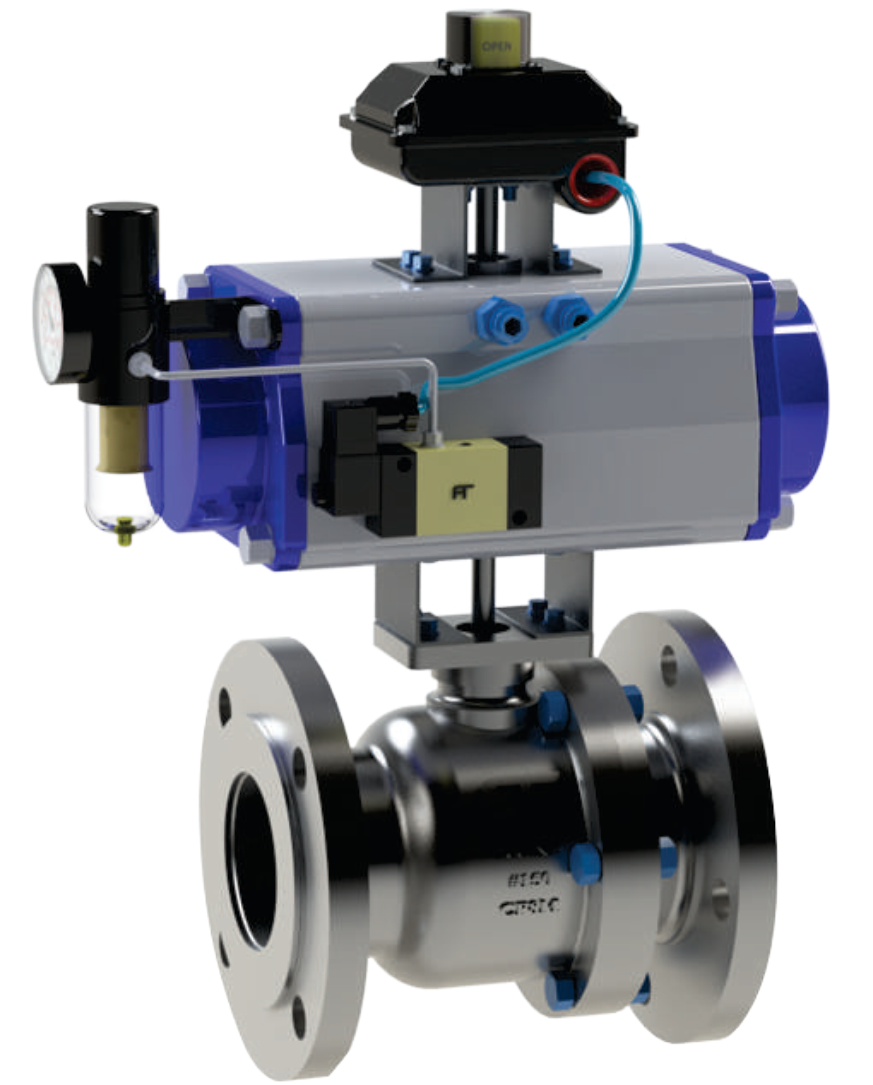
A floating ball valve holds its ball in position through the compression of two elastomeric seats rather than a fixed trunnion, letting upstream pressure push the ball into tight, bubble-tight contact with the downstream seat on every quarter turn.
For automated duty, the details around the ball matter as much as the ball itself: a blowout-proof stem prevents ejection under pressure and allows online packing replacement, while an anti-static plunger dissipates the static charge that friction between the ball and soft seat can generate — a real fire risk in hydrocarbon service.
Fire-safe secondary metal seats, tested to API 6FA, API 607 and ISO 10497, mean the valve still achieves a leak-tight shutoff even after the primary soft seat has burned away — and an automatic cavity relief system protects the seats and ball from over-pressurisation once trapped cavity pressure exceeds 1.3 times the rated pressure.
We supply the Freture Techno range of one, two and three-piece floating ball valves from 15 NB to 300 NB, #150 to #600, in stainless steel, carbon steel and alloy, with manual, pneumatic or electric actuation. Talk to our team about matching the right body style and actuator to your isolation or ESD application.